
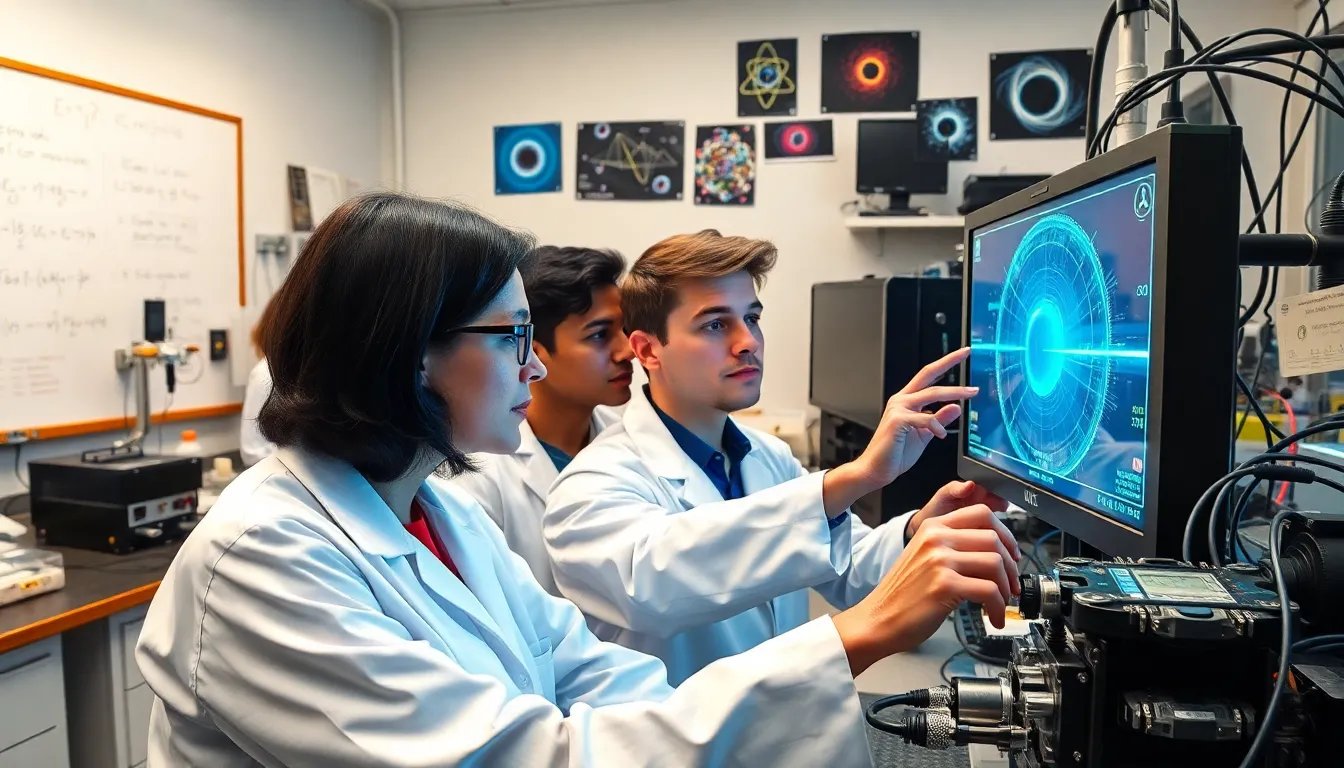
Physics has a knack for unraveling the universe’s most perplexing mysteries, and recent research findings are no exception. From the tiniest particles to the vastness of black holes, scientists are pushing boundaries and challenging what we thought we knew. It’s like watching a cosmic game of hide and seek, where every discovery reveals more questions than answers.
Overview of Recent Physics Research Findings
Recent advancements in physics research reveal significant insights into fundamental particles and cosmological phenomena. Studies on the Higgs boson continue, enhancing understanding of its properties and implications for the Standard Model of particle physics. Detecting and analyzing rare events strengthens theories concerning mass generation.
Astrophysicists recently published findings on black holes, discovering that they might be more common than previously thought. Observations from various telescopes indicate that supermassive black holes reside at the center of most galaxies, including the Milky Way. These findings reshape theories about galaxy formation and evolution.
Quantum mechanics sees ongoing exploration, particularly in quantum entanglement. Researchers demonstrate practical applications, including advancements in quantum computing and secure communication systems. Results show that entangled particles maintain correlations over vast distances, challenging notions of locality.
Interdisciplinary efforts merge physics with other scientific fields. For instance, climate models now incorporate physical principles to examine the effects of climate change more accurately. Applications of physics in medicine are also notable; ongoing research in medical imaging technologies enhances diagnostic capabilities.
Furthermore, gravitational wave astronomy is in a transformative phase. The detection of merging black holes and neutron stars deepens knowledge of extreme physical conditions. Data from gravitational wave observatories provide new insights into the universe’s structure and origins.
Each recent discovery opens new avenues of inquiry. As researchers continue to explore these emergent themes in physics, questions previously hidden in the cosmic game of hide and seek will seek answers. Investigations illuminate the universe’s complexities, fostering deeper comprehension of both the micro and macro realms.
Breakthroughs in Fundamental Physics

Recent discoveries in fundamental physics continue to reshape scientific understanding. These breakthroughs enhance knowledge and spark new questions across various domains.
Quantum Mechanics Advances
Recent studies in quantum mechanics reveal significant advances in quantum entanglement. Researchers demonstrate how particles remain interconnected regardless of distance, influencing fields like quantum computing. Innovations in photon manipulation further pave the way for secure communication methods. By exploring coherent superposition, scientists unlock possibilities for enhanced information processing models. Experiments consistently affirm the principles of quantum theory, reinforcing the foundational elements of physics.
Relativity Research Updates
New findings in relativity research challenge traditional views on gravity. Researchers identify anomalies in gravitational wave patterns, indicating previously unobserved interactions between massive objects. Observations of light bending around black holes provide fresh evidence for Einstein’s theories. Additionally, studies on cosmic inflation offer insights into the universe’s early moments, influencing current cosmological models. By investigating the fabric of spacetime, physicists expand on the implications of relativity within both astrophysics and high-energy physics.
Applied Physics Innovations
Applied physics research leads to groundbreaking developments that enhance technology and society. These innovations span various fields, including energy generation and materials science.
Energy Generation Techniques
Recent advancements in energy generation focus on renewable sources and efficiency improvements. Researchers explore solar panels, increasing their efficiency through advanced materials and designs. Wind energy technologies undergo significant enhancements, maximizing output with innovative turbine designs. Additionally, nuclear fusion research aims to create a viable, clean energy source, promising greater sustainability. Breakthroughs in thermoelectric materials enable efficient waste heat conversion into electricity. Enhanced battery technologies also emerge, improving energy storage capabilities and promoting electric vehicle adoption.
Materials Science Developments
Materials science experiences a revolution with advancements in nanomaterials and composites. Nanotechnology plays a crucial role in developing stronger, lighter materials for aerospace and automotive industries. Researchers create graphene-based materials, resulting in improved conductivity and mechanical strength. Bioinspired materials emerge, mimicking natural structures for enhanced performance in various applications. Smart materials that respond to environmental changes contribute to innovations in wearable technology. Additionally, advancements in 3D printing reduce production costs, allowing for rapid prototyping of complex designs and enabling customization.
Interdisciplinary Approaches in Physics
Interdisciplinary approaches in physics blend concepts from various fields, fostering innovation and deeper insights into complex problems. Collaboration between physics and disciplines like biology, chemistry, and computer science enhances research outcomes.
Collaboration with Other Sciences
Physics research increasingly relies on collaboration with other scientific fields. Integrating methods from cognitive science reveals how physical principles apply to complex biological processes. Partnerships with materials science are essential for exploring nanomaterials, which have vast implications from electronics to medicine. Additionally, cooperative research with environmental science improves understanding of energy systems, promoting sustainable technology solutions. The convergence of ideas propels advancements that wouldn’t occur in isolation.
Impact on Technology and Engineering
Physics research significantly impacts technology and engineering, driving innovations across industries. Breakthroughs in quantum mechanics lead to advancements in quantum computing, enhancing processing capabilities far beyond classical systems. Innovations in photonics improve communication technologies, enabling faster and more secure data transmission. In renewable energy, fundamental discoveries facilitate better solar panel efficiency, paving the way for broader adoption. Additionally, physics-informed algorithms optimize engineering designs, ensuring products meet rigorous performance standards. These transformative impacts illustrate the vital role of physics in shaping modern technology and engineering practices.
Future Directions in Physics Research
Emerging fields within physics research promise to deepen understanding of the universe. Quantum technology stands at the forefront, with advancements in quantum computing and information science driving innovation. Researchers explore quantum entanglement further, anticipating its critical role in secure communications and computational efficiency.
Expanding on gravitational wave astronomy, future studies expect to unveil more about black holes and neutron stars’ interactions. Observations will likely enhance knowledge regarding the universe’s structure and evolution. New detection methods may reveal previously hidden merging events, shaping theoretical models.
Further exploration into cosmic inflation sheds light on the universe’s beginnings, particularly how rapid expansion influenced cosmic structures. These inquiries could refine existing cosmological models and lead to groundbreaking insights into fundamental physics.
In addition to theoretical advancements, applied physics innovations emerge continually. Renewable energy sources, such as solar and wind, receive a significant focus, with enhanced technologies promising increased efficiency. Nuclear fusion research progresses toward attaining practical clean energy solutions, aiming to address global energy challenges effectively.
Materials science also evolves, with ongoing research into nanomaterials and graphene-based substances contributing to diverse applications. Innovations in 3D printing enhance rapid prototyping possibilities, directly impacting manufacturing and design processes.
Interdisciplinary collaboration remains vital. Blending ideas from biology, computer science, and environmental studies fosters innovative strategies that address complex problems. Engaging with other scientific domains amplifies physics research’s impact on technology and engineering, driving advancements in areas like renewable energy and quantum technologies.
The ongoing discoveries in physics not only deepen our understanding of the universe but also drive technological advancements that impact everyday life. As researchers continue to explore the intricacies of fundamental particles and cosmic phenomena, the implications of their findings extend into various fields.
Interdisciplinary collaboration remains crucial as it fosters innovative solutions to complex challenges. The future of physics research holds immense promise, particularly in quantum technology and renewable energy, paving the way for sustainable practices.
These advancements reflect the dynamic nature of scientific inquiry and its potential to transform our world. As the quest for knowledge persists, the universe’s mysteries will likely unfold, inspiring future generations of scientists and innovators.

